“Consulting without taking action” alienates younger people from public policy
ALC and Young Social Innovators propose replacing traditional opinion polls with new digital listening tools (European Youth Listening Lab) that enable these perceptions to be linked to social innovation processes.
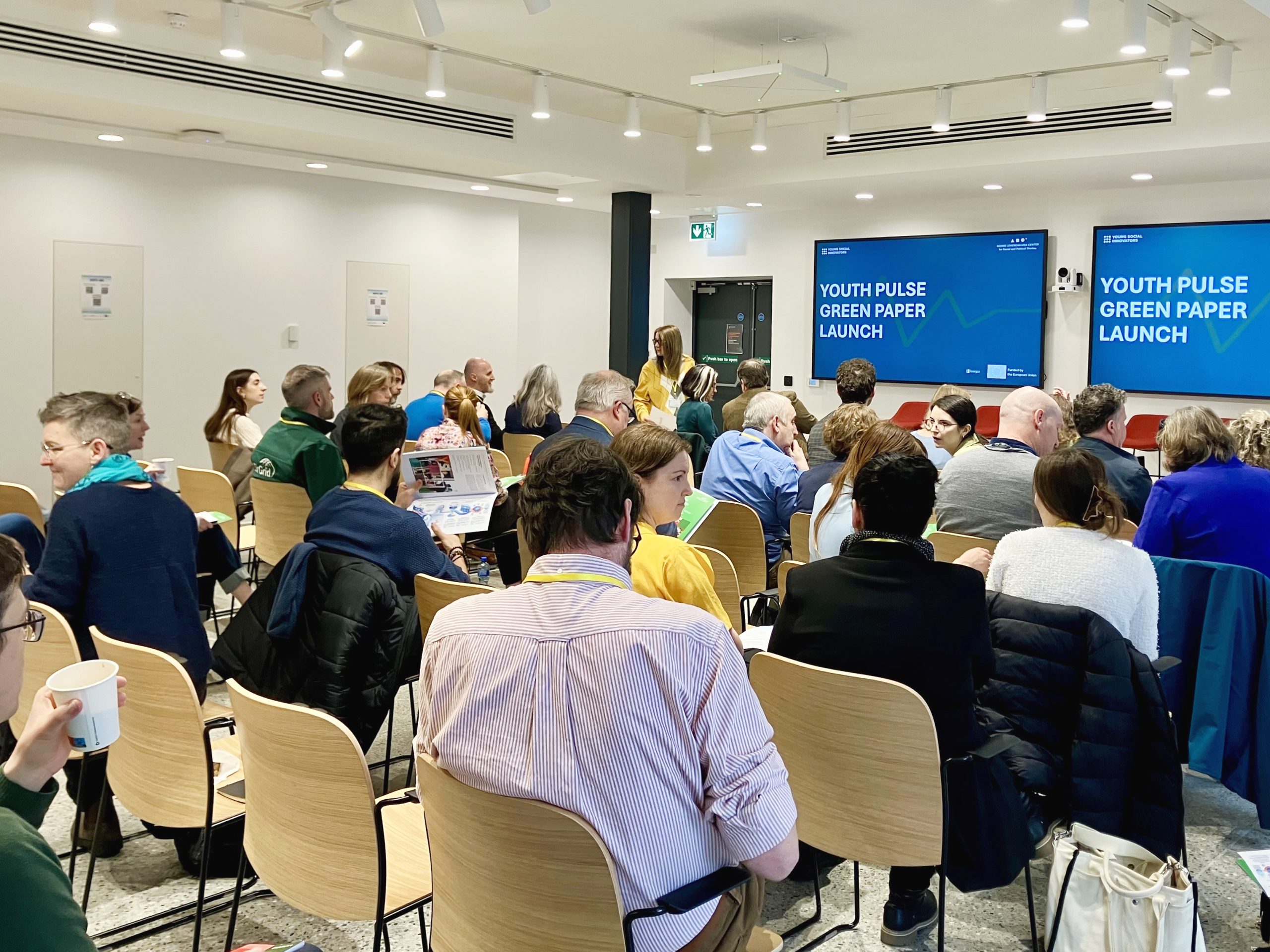
On February 26, Agirre Lehendakaria Center (ALC) and Young Social Innovators (YSI) presented in Dublin the green paper on the future of democracy and social innovation in Europe: “Enabling Young People to Have a Voice – An EU Perspective.” This document proposes moving away from traditional opinion polls to new digital tools that allow social perceptions to be gauged in real time and that can be connected to social innovation processes.
The report notes that young Europeans are going through a period of profound uncertainty, marked by inequality, climate anxiety, digital transformation, and changes in the labor market. However, despite the existence of frameworks such as the EU Youth Strategy, many young people feel that their opinions fail to influence decisions that directly affect their lives.

The report identifies that Europe does not suffer from a lack of surveys or consultations, but rather from fragmented efforts that are disconnected from innovation and social experimentation processes. Participation is often an isolated or symbolic exercise, and the document clearly warns that “voices without interpretation, response, and feedback actively erode trust.” The document refers to this structural gap between gathering opinions and generating concrete actions as the missing middle. To bridge this gap, the Green Paper does not propose creating an isolated tool, but rather an integrated ecosystem of “collective listening and interpretation” (sentiment and sense-making) composed of three complementary pillars:
-Youth Pulse: A participatory framework that continuously and inclusively captures the real experiences, priorities, and concerns of young people.
-Echoboard (YSI): It functions as a translation layer that aggregates and visualizes data generated by young people, creating a shared reference point for dialogue and accountability with decision-makers.
-K-Tool (ALC): A governance platform that places these youth opinions within broader ecosystems of social innovation, enabling coordinated responses, experimentation, and impact assessment.
Together, these tools ensure that young people's voices are structured, contextualized, and translated into concrete social innovation actions. This model has not been built on abstract assumptions, but rather on “deep listening” panels conducted with young people from the YSI Youth Panel (Ireland) and students from the University of Mondragón. Participants confirmed that they do not want to participate in “box-ticking exercises”; they demand that their participation has a purpose and is explicitly linked to social innovation, political dialogue, or tangible change. In addition, they showed great interest in understanding how other young people in Europe face similar challenges, seeking to build solidarity beyond their borders.


Finally, the Green Paper emphasizes that “listening is a responsibility of the system, not an isolated activity.” It is therefore launched as an open invitation for EU institutions, Member States, youth organizations, and researchers to collaborate in its development.
As a first major step, the document proposes the creation of a European Youth Listening Lab: a collaborative space where pilot projects and lessons learned can converge, treating young people's perceptions not as data to be extracted, but as wisdom to guide the future.