
ALC and Action Against Hunger Present the Initial Progress of the #StopMalnutrition Project
Agirre Lehendakaria Center and Action Against Hunger (ACH) have completed their first months of joint work on the #StopMalnutrition project, co-financed by the European Social Fund Plus (ESF+) under the Social Innovation Priority of the State Program for Social Inclusion, Child Protection, and the Fight Against Poverty.
The first semi-annual report on the process details the main progress and lessons learned between April and July 2026 in four regions: Madrid, Galicia, Andalusia, and the Basque Country. The initiative aims to understand the dynamics that lead to child food insecurity in diverse contexts and to incorporate a nutrition-sensitive approach into social protection systems.
An Evolutionary Evaluation Approach to Transform the System
Unlike conventional evaluation models, ALC supports the project through an evolutionary evaluation methodology. This approach views evaluation as a continuous learning system that accompanies implementation in real time, facilitating decision-making and the constant adaptation of the intervention as new evidence emerges.
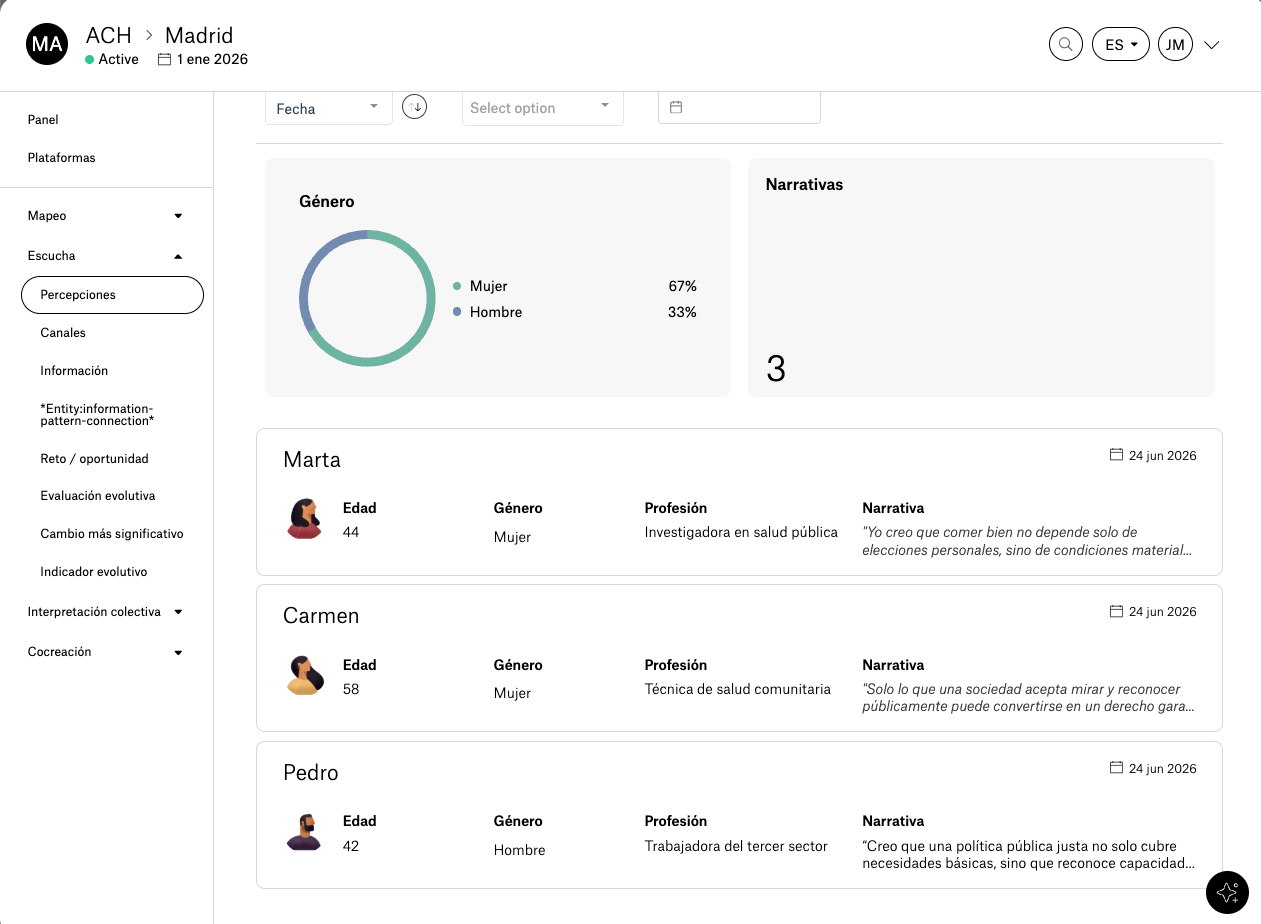
The process is based on four interrelated methodological competencies: systemic mapping of the ecosystem, deep listening to perceptions, collective interpretation of knowledge, and the co-creation of innovation portfolios and prototypes. All information is managed in the K tool, ALC’s digital platform that uses artificial intelligence to streamline qualitative systematization and identify narrative patterns.
At the same time, the project is helping to develop the profile of community connectors—key professionals who build trust in the region, coordinate local networks, and continuously feed data into the K tool.
Key Findings by Region
The fieldwork conducted during these first few months has made it possible to develop initial stakeholder maps, gather initial perceptions, and hold collective interpretation sessions, from which key conclusions are beginning to emerge in each context:
- Madrid: Child food insecurity remains a largely invisible phenomenon that is often hidden within households. The narratives collected point to the need to move beyond approaches focused solely on individual habits in order to address socioeconomic determinants. They also highlight the potential of school cafeterias as spaces for equity and the opportunity to bridge the social sciences with the health sciences.
- Andalusia (Seville): Analysis across several neighborhoods reveals the impact of socioeconomic vulnerability and urban food environments. The interviews agree that material aid must be accompanied by family support and community strengthening, while also incorporating the emotional dimension of food. Based on these findings, progress is being made in conceptualizing a platform for inter-institutional and community collaboration in the city.
- Basque Country: The interviews highlight the need to broaden our understanding of child malnutrition within a framework of rights, food quality, and food sovereignty. School cafeterias are emerging as strategic spaces for ensuring adequate nutrition and promoting food education. The lack of coordination among government agencies and departments is identified as one of the main challenges to be addressed.
- Galicia (Vigo and Nigrán areas): With a distinctly community-based approach, the conversations reveal a close link between available time, job insecurity, work-life balance, and the ability to maintain healthy eating habits. The feminization of care emerges strongly as a structural factor, as does the need to prioritize early prevention over purely reactive care responses.
Next Steps
During the second half of 2026, the project plans to expand the listening process to include children and adolescents through participatory methodologies such as Photovoice. Additionally, new in-person collective interpretation sessions will be held in the four regions to define the first innovation portfolio and begin the co-creation of the first social intervention prototypes.