Place-Based Innovation Policy in Dialogue: Greater Manchester and the Basque Country
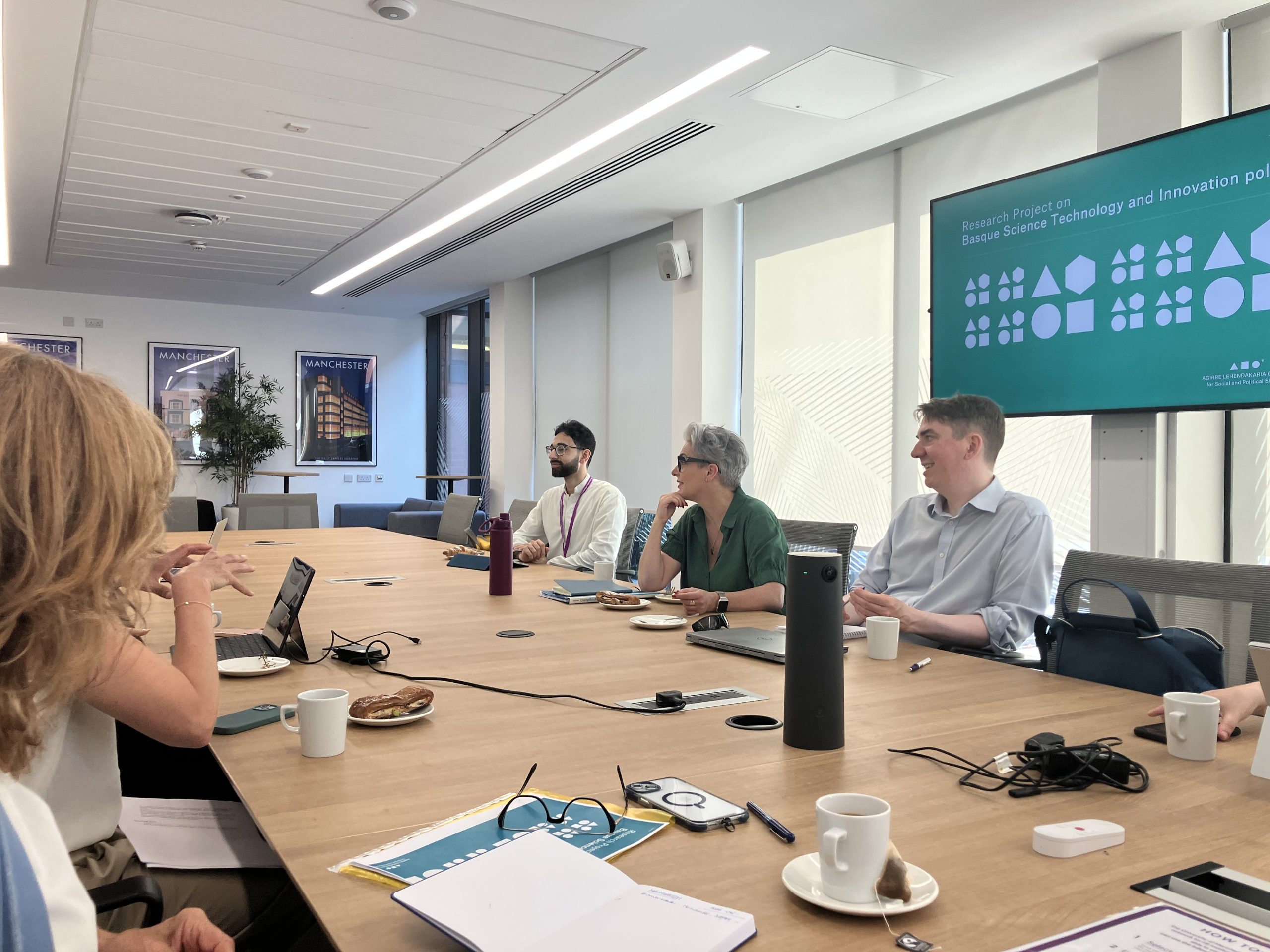
Roundtable, Alliance Manchester Business School | 26 June 2026
Participants:
Elvira Uyarra (MIoIR, University of Manchester) Gorka Espiau (Agirre Lehendakaria Center, University of the Basque Country), Julia Martinez (Agirre Lehendakaria Center, University of the Basque Country), Alan Harding (GMCA & University of Manchester), Rubén Sanz Ferrero (Consulate General of Spain in Manchester), Matt Ziembla (MIoIR, University of Manchester), Usman Aziz (MIoIR, University of Manchester), Mabel Sanchez Barrioluengo (MIoIR, University of Manchester), Matthew Kershaw (GMCA), Coral Grainger (economic development and skills specialist), Kieron Flanagan (MIoIR, University of Manchester), Katie Penney (The Productivity Institute, University of Manchester), Mandy Parkinson (University of Salford).
Summary of Discussion:
1. Innovation as long-term territorial transformation
The roundtable brought together researchers, policymakers and practitioners from Greater Manchester and the Basque Country to explore the evolution of place-based innovation policy, compare experiences, and identify lessons for future regional development.
It opened with a presentation of the Basque research project, which traces 50 years of science, technology and innovation policy from the restoration of self-government to the present day. The Basque case was presented as a rare instance in which industrial modernisation, economic growth, social development and reductions in inequality have progressed together over several decades.
A central argument of the research is that understanding why certain decisions were taken matters as much as cataloguing what policies were implemented.
2. Collective leadership, pragmatism and crisis as catalyst
A recurring question was whether successful territorial transformation is driven primarily by visionary leadership or by broader collective action. In the Basque case major policy shifts emerged from a combination of political leadership and strong social consensus, with periods of crisis creating conditions for collaboration and cross-institutional experimentation.
Participants drew parallels with Greater Manchester, where progress has often depended on pragmatic working relationships between local authorities, universities, national government and other stakeholders, rather than on formal political alignment. The discussion suggested that successful transformation needs both strong leadership and a sense of collective ownership.
3. Technology-led versus science-led innovation systems
One of the sharpest contrasts between the two regions concerned the relationship between universities, science and innovation. The Basque model was described as historically technology-led rather than science-led. During industrial decline in the 1980s, public investment was directed towards technology centres closely linked to industry, rather than primarily towards universities. These centres became the core innovation infrastructure, helping firms modernise rapidly and strengthening manufacturing competitiveness. Universities, by contrast, remained more peripheral to the innovation system and were valued mainly for educating skilled professionals rather than as central generators of knowledge for innovation. This historical path continues to shape the Basque innovation system today.
Greater Manchester's ecosystem, by contrast, relies much more heavily on universities as central innovation actors. The discussion then turned to how future innovation systems in both regions might better connect technological capability, scientific research and the demands of societal challenge.
4. Manufacturing, deindustrialisation and place-based development
The importance of manufacturing emerged repeatedly. The Basque decision to maintain a commitment to industry during the period of decline was described as deliberate and, at the time, unconventional: rather than abandoning manufacturing, public investment supported technological upgrading and industrial restructuring.
Participants reflected that the UK largely moved in the opposite direction, with significant deindustrialisation and a stronger emphasis on property-led regeneration. Current initiatives in Greater Manchester, including Atom Valley and advanced materials programmes, were discussed as efforts to reconnect innovation policy with manufacturing, productivity and place-based economic development.
5. Universities and local innovation ecosystems
The role of universities generated substantial discussion. Participants pointed to several complementary contributions: educating and attracting talent, conducting research, supporting innovation ecosystems, and working with businesses and public institutions. There was also debate about whether universities can sometimes become overly dominant within local innovation systems, and conversely whether they can remain insufficiently connected to the wider economy and society.
Particular attention was paid to the challenge of engaging smaller firms and businesses that do not identify themselves as part of the innovation ecosystem. Examples were shared of work with further education colleges and applied innovation programmes that have successfully connected innovation support with firms that might otherwise be excluded from policy discussions.
6. Ecosystem complexity and institutional architecture
Several participants observed that both regions now operate within increasingly complex ecosystems of ecosystems. This raised questions about how much institutional complexity is useful, whether multiple organisations and governance layers enhance resilience or create duplication, and how coordination can be achieved without becoming overly bureaucratic.
The Basque case was presented as a highly networked and collaborative system in which many institutions operate with considerable autonomy while remaining broadly aligned around shared goals. Questions were raised about how this alignment is maintained, and whether it can be sustained as the agenda broadens and the number of actors grows.
7. Inclusive growth and social outcomes
A significant point of interest was the relationship between innovation and inequality. The discussion explored whether innovation policies tend to concentrate benefits in particular sectors or places, and how systems can be designed to distribute gains more widely.
The Basque experience was discussed as evidence that innovation-led growth can be combined with social inclusion when policies sit within a broader framework of social protection, education investment and collective governance. Participants agreed that innovation systems should be judged not only by economic indicators, but also by their social impact, contribution to wellbeing and capacity to support inclusion.
8. Shared challenges looking ahead
The conversation concluded by identifying several challenges facing both regions:
Talent and demography: attracting and retaining skilled workers, responding to ageing populations, and competing internationally for talent.
Public and private investment: leveraging public investment effectively and increasing private-sector commitment to innovation.
New strategic missions: identifying future transformative projects capable of mobilising diverse actors, and avoiding complacency based on past success.
Science, technology and society: building stronger connections between scientific capability and societal needs, and demonstrating public value from research and innovation investment.
Evaluation and learning: moving beyond programme-level indicators, understanding how innovation ecosystems evolve over time, and developing better approaches to evaluating systemic change.
The discussion suggested that Greater Manchester and the Basque Country offer contrasting but mutually informative examples of place-based innovation policy. Their institutional histories are very different, but both cases underline the importance of long-term commitment, trusted relationships, strong civic institutions, and the ability to connect innovation policy to wider economic and social priorities.