Results of the Urdaibai Listening Process, what now?
Home Nuestro trabajo Results of the Urdaibai Listening Process
Urdaibai has everything it needs to become an advanced learning space for the sustainable human development of Basque society. In addition to the characteristics of the environment, institutional and social efforts to promote a new transformation of the territory and, above all, the commitment of its citizens, make it possible to attract talent and investment to test a set of specific initiatives that can subsequently be scaled up to the entire Basque Country.
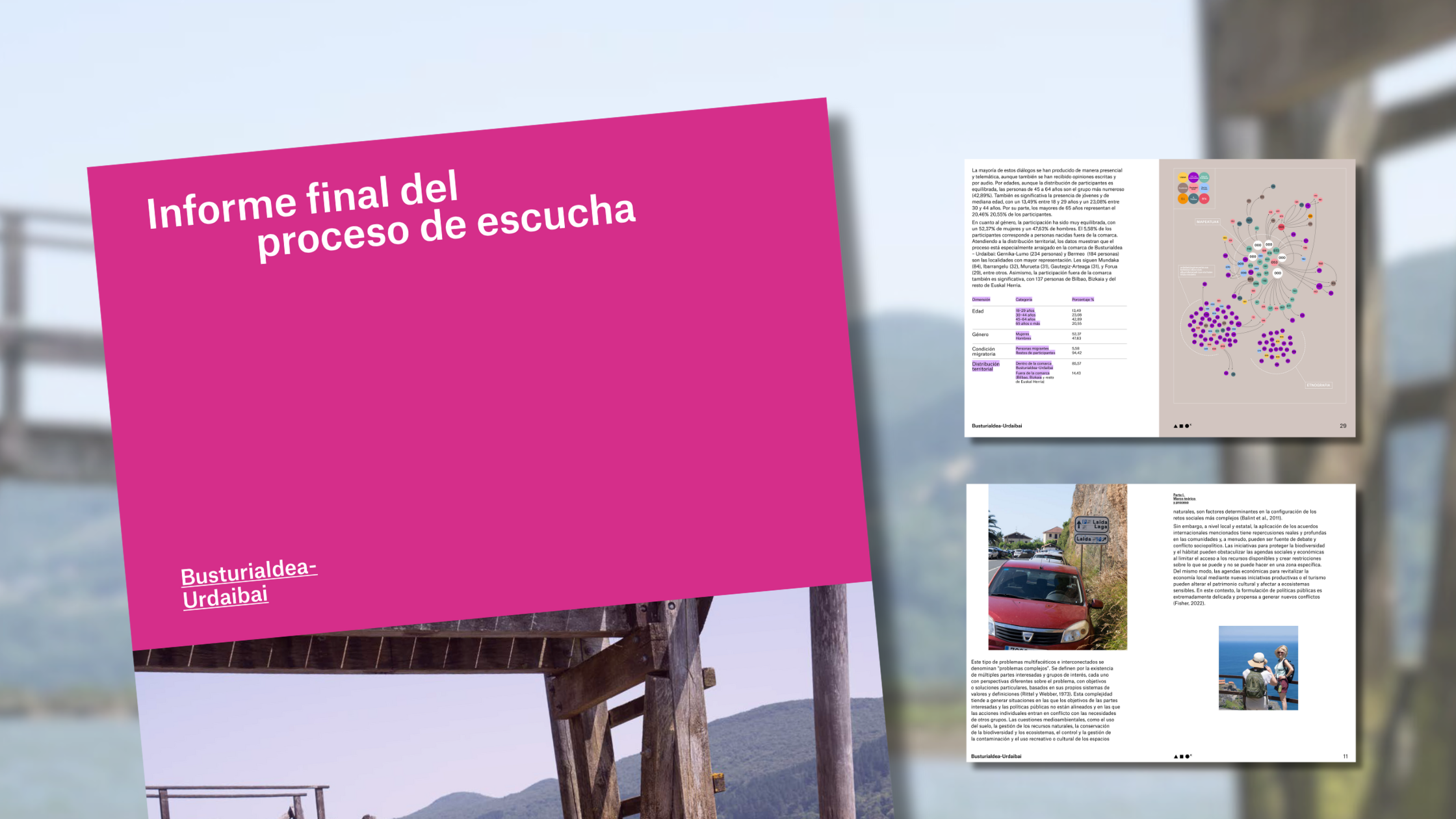
This report compiles the findings of the listening process in Busturialdea-Urdaibai on the possible expansion of the Guggenheim Bilbao Museum in the region and complements the previous report published in July 2025. During the 10 months of this process, 1,002 individual narratives were collected and verified through seven collective interpretation sessions. All this information was verified and enriched at the international seminar held at Ekoetxea on December 1 and 2, 2025.
Now that Basque institutions have decided not to proceed with the museum expansion project in Urdaibai, this document remains valid for enriching the debate on how Basque society can tackle the necessary socio-ecological transition in the region.
During the listening process, five narrative patterns emerged that reflect the different ways of positioning oneself in relation to the initiative and the future of the region. As we have pointed out, it is not possible to speak of majorities or minorities, but rather of prevalences, understood as trends with greater presence, density, argumentative maturity, or repetition over time. The interpretation of prevalences has been possible thanks to the volume, frequency, and intensity of narratives and the seven contrast sessions held during 2025, as reflected in the preliminary report on narrative patterns. The narratives identified reveal cross-cutting effects between conservation, tourism, housing, employment, and mobility. Therefore, the narratives have reflected that the debate is not only about the expansion of the museum, but also about how to address the socio-ecological transition of the region and what role each agent in the region can play.
There are differences, but also broad consensus on the development of the region. Based on the narratives gathered, no one questions the need to combine environmental protection with the socio-economic development of Busturialdea-Urdaibai, or the framework of the biosphere reserve. As was evident at the international seminar, there are not many similar conflicts in which such broad consensus exists. This consensus provides a unique foundation for building a shared future in the region based on diversity.
Regardless of whether participants rejected the project, supported it, or had doubts, they agreed that the region needs to act, move forward, and make strategic decisions as a pioneer of green development in a biosphere reserve. The initial Not In My Back Yard attitude (in which many people who rejected the project viewed it favorably in other places) has evolved into a more nuanced position focused on the future of Urdaibai. The process itself has made it possible to highlight and compare different ways of viewing the project and the development of the region. Thanks to this exercise in public dialogue, all positions have introduced nuances that did not previously exist in their discourse, and common elements have been made explicit.
Once the decision was made not to proceed with the museum expansion project, the concerns and suggestions of those organizations that opposed it were acknowledged. At the same time, the institutions that facilitated this process, taking political and electoral risks that are normally considered excessive, were able to see how their commitment to the development of the region was enriched by very specific contributions. All the efforts of these social and institutional actors should be recognized. Instead of a win-lose confrontation, the listening process has made it possible to envision a future scenario in which the entire region can win.
What now?
The challenge from now on is not to close the debate, but to restart the discussion and give it new content, preventing the void that has been created from turning into paralysis or disaffection. Instead of proposing new specific solutions, the narratives collected call for strengthening the current strategic plan with new initiatives that complement the necessary investments in infrastructure that have already been committed to. These initiatives should address the different topics gathered during the listening process (Housing, Transportation, Culture, Employment, Tourism, Culture, and Ecology) rather than focusing all efforts on a specific area. In this context, it is suggested that we explore what other specific contributions the Guggenheim Museum Bilbao could make to the region, now that the decision has been made not to continue with the expansion project.
Considering the above, the listening process could be kept active (integrating other existing participation processes) as a stable space for public debate and feedback, reinforcing its educational nature and its role in generating advanced knowledge. This would involve continuing to incorporate new voices—especially young people, migrants, and residents of small municipalities—promoting intergenerational and territorial dialogue, and exploring tools capable of simulating new development scenarios. Far from being exhausted in a specific discussion, the listening process could be transformed into a strategic tool for managing tensions between protection and development, articulating a collective project that combines identity, sustainability, and well-being.
Based on this experience, we can affirm that Urdaibai meets all the conditions to become an advanced learning space for the sustainable human development of Basque society. In addition to the characteristics of the environment, institutional and social efforts to promote a new transformation of the territory and, above all, the commitment of its citizens, make it possible to attract talent and investment to test a set of specific initiatives that can subsequently be scaled up to the whole of the Basque Country.