CESAL
Home Nuestro trabajo CESAL
CESAL is a non-governmental organization that has been working since 1988 to promote human development among the most vulnerable people. Internationally, it promotes interventions in Africa, Latin America, and the Middle East, while in Spain it supports individuals and families at risk of social exclusion.
ALC carries out the developmental evaluation of the ISOT (Social Innovation in Traditional Trades) project.
The collaboration between CESAL and Agirre Lehendakaria Center is part of CESAL's Operation Innovation, an initiative aimed at evaluating the organization's projects in an evolutionary manner and strengthening its social innovation capabilities. Specifically, ALC will accompany the developmental evaluation process of the ISOT (Social Innovation in Traditional Trades) project, measuring progress and learning over time, while promoting the autonomy and local leadership of CESAL's teams.
This alliance reinforces the shared commitment of both organizations to promoting social innovation based on collective learning, strengthening local capacities, and fostering models of social and labor integration connected to the dynamics and real needs of each territory.
Operation ISOT, co-financed by the European Union—through the European Social Fund Plus (ESF+)—and the Ministry of Labor and Social Economy, seeks to generate new models of training and job placement for people in vulnerable situations. Its purpose is to innovate in training processes linked to traditional trades in the food and local commerce sectors, strengthening employability, creating opportunities for the future, and ensuring the sustainability of professions that today require generational renewal.

The project is being developed through the design, testing, and evaluation of three pilot models with public-private partnership approaches tailored to each context:
-Madrid: a comprehensive model based on the San Cristóbal Market School, which combines practical training in trades such as butchery, fishmongering, and catering with a master-apprentice approach.
-Granada: a model in partnership with training institutions, companies, and municipal centers that combines technical training with internships in shops and supermarkets.
-Valencia: a model based on direct collaboration with trade associations and small businesses, where master bakers, pastry chefs, and other professionals pass on their skills in real work environments.
Each pilot program develops tailored training itineraries that integrate practical learning, digital skills, social skills, and career guidance, always using the “learning by doing” methodology that CESAL has already successfully applied in its training restaurants.
ISOT's innovation lies not only in the design of the pilots, but also in their evolutionary evaluation. In collaboration with ALC—a social innovation center specializing in transitions toward Sustainable Human Development at the University of the Basque Country and Columbia University—the results will be analyzed in real time, identifying barriers and opportunities to adapt the models to each context. This process will allow the prototypes generated to be replicable and scalable to other sectors, territories, and public policies.
In addition, the project will develop a methodological guide for training in traditional trades, which will compile the lessons learned and serve as a reference for public institutions, social entities, and companies committed to employability through social innovation.
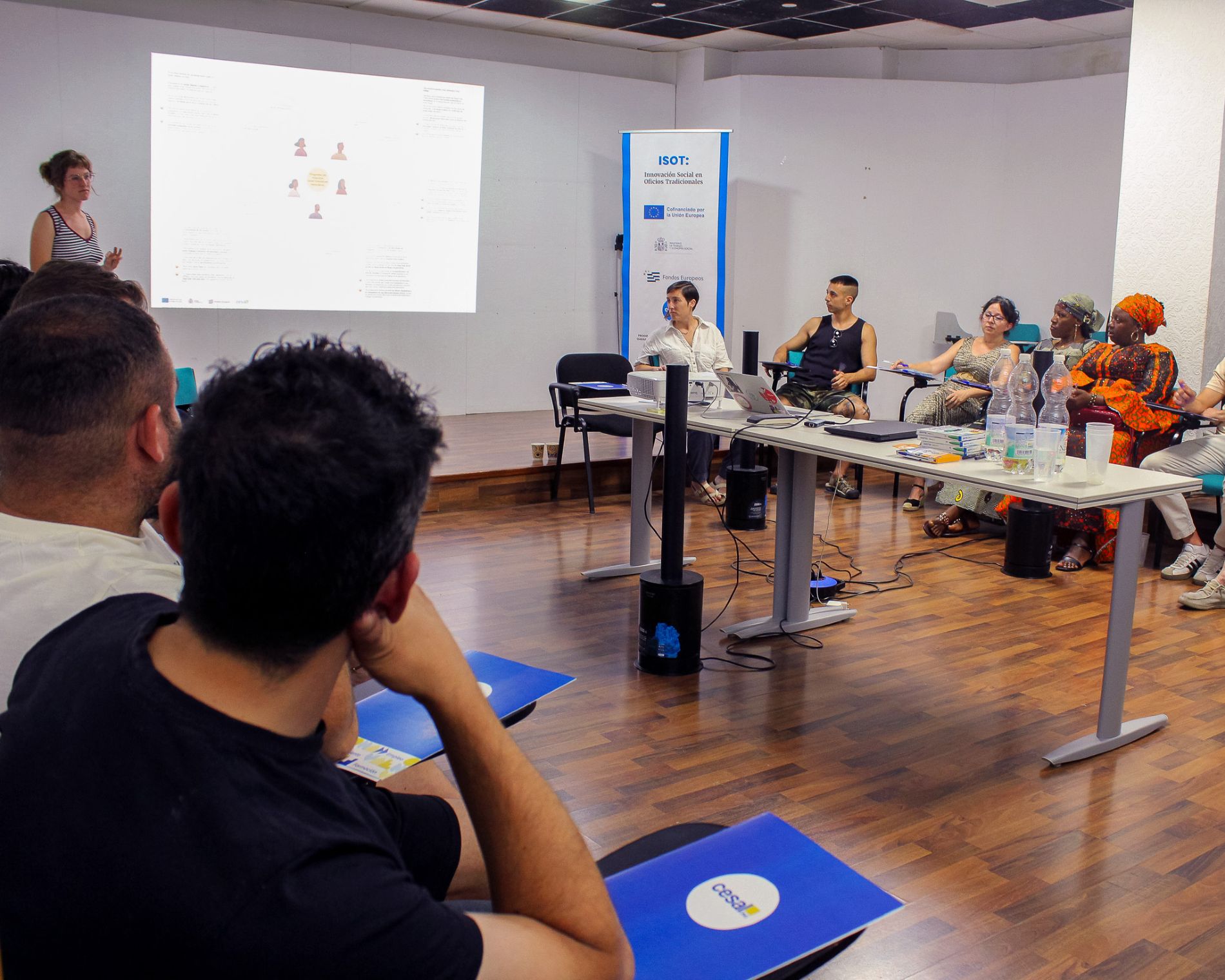
The ISOT project launches 10 community-based pilot projects for social and labor inclusion

Social Innovation at the San Cristóbal Market School

ALC and CESAL advanced in the co-creation of the Social Innovation Guide

First collective interpretation with CESAL Valencia

Training on Developmental evaluation with CESAL teams